
THE BUYER'S GUIDE / SELECTION
Choosing Expansion Wedge Anchor: Application Fit and Specification Checks
This guide helps procurement teams and project engineers select the right wedge anchor by examining base material compatibility, diameter and length requirements, surface finish options, and load demands. Drawing on confirmed product specifications from Yongnian Country Tianbang Fasteners Co., Ltd, the article covers the Expansion Wedge Anchor range — M6 to M24 in diameter, 40 mm to 400 mm in length — and explains how each key variable maps to real-world fastening scenarios in construction, infrastructure, and industrial applications.

Base material must be solid concrete — wedge anchors expand mechanically against the hole wall and cannot develop adequate holding in hollow masonry or soft substrates.
Diameter and length must satisfy both the calculated design load (referenced against pull-out load values for M6–M24) and the combined embedment depth plus fixture thickness constraints given in the confirmed size table.
Surface finish (plain, zinc-plated, black, or HDG) must match the corrosion exposure category of the installation environment.
Manufacturing standard (DIN, ANSI, ISO, or GB) must align with the applicable project or regional code requirement.
Grade 4.8 carbon steel Q235 covers general-purpose static-load anchoring; applications requiring higher grade or alternative materials must be confirmed with the supplier.
What Is a Wedge Anchor and How Does It Work?
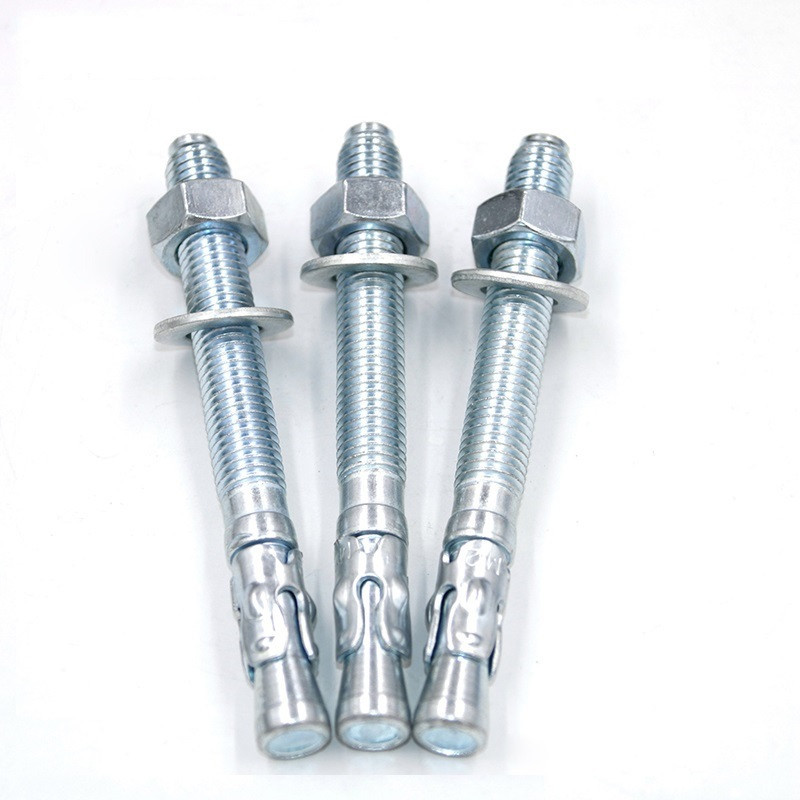
A wedge anchor — also called a through bolt — is a mechanical expansion anchor designed for use in solid concrete. When the bolt is tightened, a clip or wedge at the base expands outward against the wall of the drilled hole, generating friction and mechanical interlock that resist both pull-out and shear forces. Because the holding mechanism is purely mechanical and activates under load, wedge anchors are predictable, field-verifiable fasteners well-suited to structural connections.
The Expansion Wedge Anchor range offered by Yongnian Country Tianbang Fasteners Co., Ltd covers diameters from M6 to M24 and lengths from 40 mm to 400 mm, with carbon steel Q235 as the standard material and multiple surface finish options. Customization is available for projects with non-standard requirements.
Key Selection Criteria
Choosing the correct wedge anchor requires evaluating several interdependent variables. The sections below address each criterion in sequence so buyers can narrow the specification before contacting a supplier.
1. Base Material: Concrete Only
Wedge anchors rely on mechanical expansion into a rigid substrate. They are designed for solid, hardened concrete. Do not specify a wedge anchor for hollow masonry, brick, or soft materials — the wedge cannot develop adequate bearing against those substrates. If your project involves a non-concrete substrate, a different anchor type is required.
2. Diameter Selection
The available diameters — M6, M8, M10, M12, M14, M16, M20, and M24 — correspond to different load capacities. The confirmed size chart shows indicative pull-out loads that increase with diameter:
| Diameter | Indicative Pull-Out Load |
|---|---|
| M6 | 850 kgf |
| M8 | 1,150 kgf |
| M10 | 1,500 kgf |
| M12 | 2,300 kgf |
| M16 | 3,400 kgf |
| M20 | 5,400 kgf |
Note: The values above are reference figures from the product data sheet. Actual site load calculations should be performed by a qualified engineer using project-specific concrete strength, edge distance, and spacing. Final specification is subject to actual product dimensions.
Begin with the calculated design load and select the smallest diameter that meets it, factoring in a code-specified safety factor. Oversizing adds unnecessary material cost; undersizing creates a safety risk.
3. Length and Embedment Depth
Length must be chosen to satisfy both the minimum embedment depth and the maximum fixture thickness for the intended application. The confirmed size table pairs each length option with its minimum embedment and maximum fixture thickness. For example:
- M10 × 85 mm: min. embedment 40 mm, max. fixture thickness 15 mm
- M10 × 130 mm: min. embedment 50 mm, max. fixture thickness 70 mm
- M12 × 150 mm: min. embedment 60 mm, max. fixture thickness 80 mm
- M20 × 200 mm: min. embedment 100 mm, max. fixture thickness 80 mm
The required embedment depth is driven by the concrete strength and load; the fixture thickness determines how much of the bolt shank must protrude above the surface to pass through the attached material. Always verify that the chosen length satisfies both constraints simultaneously.
4. Surface Finish and Corrosion Environment
Four surface finishes are confirmed for the Expansion Wedge Anchor:
| Finish | Typical Environment |
|---|---|
| Plain (bare steel) | Dry interior, non-corrosive |
| Zinc-plated | Indoor–outdoor, moderate humidity |
| Black (black oxide) | Lightly protected, indoor use |
| HDG (hot-dip galvanized) | Outdoor, coastal, or industrial atmospheres |
For applications in wind towers, offshore-adjacent structures, or humid industrial environments, HDG provides a substantially thicker zinc layer than electroplated options. For standard indoor construction, zinc-plated is a cost-effective choice. Plain finish should only be considered where the fixture itself provides corrosion protection or the exposure is definitively dry.
5. Application and Industry Fit
Confirmed application sectors for the Expansion Wedge Anchor include:
- Construction — structural attachments, baseplates, column anchorage
- Wind towers — high-tension anchor bolt sets in tower base flanges
- Nuclear power — critical embedment applications with quality traceability requirements
- Railway — rail clip and track infrastructure fastening
- Automotive industry — fixture and equipment mounting on factory floors
- Electronic industry — equipment anchoring in plant facilities
6. Standard Compliance
The Expansion Wedge Anchor is manufactured according to DIN, ANSI, ISO, and GB standards. Buyers sourcing for export projects or specific regional code requirements should confirm which standard designation applies to their specification at the time of inquiry.
7. Grade and Material
The confirmed grade is 4.8, manufactured from carbon steel Q235. Grade 4.8 is a general-purpose structural grade commonly used in static-load anchoring applications. If a project specification calls for a higher grade or stainless steel, clarify with the supplier before ordering; the confirmed product data covers Q235 carbon steel only.
8. Minimum Order and Customization
The confirmed MOQ is 1,000 pieces. Customization is available — buyers with non-standard diameters, lengths, finishes, or thread specifications should provide detailed requirements at the inquiry stage. Sample orders are available prior to mass production, with a standard lead time of 7–10 working days for samples.
Specification Checklist for Buyers
Before submitting an inquiry, confirm the following:
- Substrate confirmed as solid concrete — hardened, minimum thickness exceeds the required embedment.
- Design load calculated — choose a diameter whose reference pull-out load, with the applicable safety factor, meets the demand.
- Fixture thickness measured — select a length that satisfies both the minimum embedment and the fixture clearance.
- Exposure environment assessed — match the surface finish to the corrosion category of the installation site.
- Applicable standard identified — note whether DIN, ANSI, ISO, or GB applies to the project specification.
- Quantity and customization needs stated — confirm MOQ alignment and flag any non-standard requirements.
When This Anchor Does Not Apply
A wedge anchor is not suitable for:
- Cracked concrete without an anchor specifically evaluated for cracked concrete conditions
- Hollow block or masonry — the expansion mechanism requires solid bearing
- Overhead tensile applications where dynamic loading or seismic zone requirements mandate a tested and classified anchor system beyond general purpose
- Substrates other than concrete — wood, steel, or composite panels require different fastener types
For these conditions, consult a structural engineer and review alternative anchor categories.
Summary
Selecting a wedge anchor comes down to six verifiable checks: substrate type, design load and diameter, length versus embedment and fixture thickness, surface finish versus exposure, applicable manufacturing standard, and project quantity. The Expansion Wedge Anchor from Yongnian Country Tianbang Fasteners Co., Ltd addresses the M6–M24 diameter range with lengths from 40 mm to 400 mm, four surface finish options, and compliance with DIN, ANSI, ISO, and GB standards — making it a broadly applicable choice for construction, infrastructure, and industrial anchoring projects. Confirm your exact specification details with the supplier to ensure product alignment before placing an order.
THE PEOPLE

About the author
THE COMPANY
Yongnian Country Tianbang Fasteners Co., Ltd
Yongnian Country Tianbang Fasteners Co., Ltd was established in 2005, located in fasteners Industrial District Yongnian. We have more than 10 years production experience of fasteners. Our Products Yongnian Country Tianbang Fasteners Co., Ltd was established in 2005, located in fasteners Industrial District Yongnian. We have more than 10 years production experience of fasteners. Size M3-M52, length 10mm-6000mm. The annual production capacity is over 20,000 ton. Grade: 4.8, 6.8, 8.8, 10.9, 12.9.
About Us ↗Visit company website ↗YOUR NEXT STEP
Bring your brief. Start a useful conversation.
Use case, specification, quantity and delivery window: make the next conversation specific.
Post time: Oct . 28, 2026 01:12